Today we're having something original, it's like over eight thousand reviews all rolled into one! We're gonna talk about another important cyberpunk franchise, which is
Ghost In The Shell.
 Studio: Production I.G,
Director: Mamoru Oshii,
Screenplay: Kazunori Itô, Masamune Shirow (source),
Genre: Anime, Action, Thriller, Obviously Cyberpunk,
Starring: Atsuko Tanaka, Akio Ohtsuka, Tamio Ôki, Iemasa Kayumi, Kôichi Yamadera, Tesshô Genda

Studio: Bandai Visual Company, DENTSU Music And Entertainment, Kodansha,
Directors: Kenji Kamiyama, Masaki Tachibana, Itsurô Kawasaki,
Screenplay: Kenji Kamiyama, Masamune Shirow, Mamoru Oshii, Mary Claypool, Yutaka Omatsu, Yoshiki Sakurai, Dai Sato, Shotaro Suga,
Genre: Anime, Action, Thriller, Obviously Cyberpunk,
Starring: Atsuko Tanaka, Osamu Saka, Akio Ohtsuka, Kôichi Yamadera, Yutaka Nakano, Tôru Ôkawa, Takashi Onozuka, Taro Yamaguchi, Kirk Thornton, Hiroshi Yanaka, Katsumi Chô, Yûji Aoki

Studio: Production I.G,
Director: Mamoru Oshii,
Screenplay: Kazunori Itô, Masamune Shirow (source),
Genre: Anime, Action, Thriller, Obviously Cyberpunk,
Starring: Atsuko Tanaka, Akio Ohtsuka, Kôichi Yamadera, Tesshô Genda, Masato Yamanouchi, Shinji Ogawa
Well, what can I say about Ghost In The Shell (GiTS 1995)? The first movie, unlike Blade Runner, was popular and well-received at the time of its initial release, and it still remains one of the most classic and beloved anime features ever. Any way you look at it, it's a masterpiece. Then there were the sequel, GiTS: Innocence, then the TV series, GiTS: Stand Alone Complex (GiTS: SAC), and two more feature films, GiTS: Solid State Society, a closure to the SAC series, and finally, a remastered edition of the first movie, GiTS 2.0. It's all based on the Koukaku Kidoutai (which can be loosely translated as 'Mobile Armor Task Force') by the famous artist Masamune Shirow. Also, there were few video games for PSX, PS2 and PSP.
If you have seen neither of the stuff listed above, just go and watch some now, and if you've just done that, or you are already a GiTS fan, today I'm going to talk specifically about the first movie, its remastered edition and the TV series. I will only briefly talk about the videogames (since I've played them very briefly as well), the manga (it's just too much to cover, and besides, it's a source material for all the movies and TV episodes anyway, to begin with), Solid State Society (talking about it would require spoiling SAC, which I don't want to do) and Innocence (I didn't like it, honestly).
It's a gonna be a comparative analysis of sorts, paralleling the aspects from GiTS circa 1995 and SAC. GiTS 2.0 will be covered separately as a bonus, since in terms of story, delivery and characters it's just the 1995 version intact.
Buckle up, we're going in!
Motoko 'Major' Kusanagi.

Looks like in the TV show, the only smiles she ever delivers are the sarcastic ones. In the first GiTS, she felt more alive and sympathetic, and her character was way more developed and memorable. Her every gesture, spoken line, every animation frame were in place and looked naturally. However, in SAC, she comes off more like a cliche badass girl-wth-a-gun, which sure is cute, but gets pretty old soon. Unlike GiTS 1995, she doesn't have anything interesting to say in SAC, except of some jokes during the 2nd season (2nd GIG), and also there are a couple of funny tributes to the first movie in the very beginning and at the end of TV show.
Winner: GiTS 1995
Batou.

A complete opposite of the Major's situation! His role in GiTS 1995 one was mostly all about SRS BZNS faces and expressive arms waving, and the dialogue felt like he doesn't care too much about what's going on. However, in SAC he has received a significant upgrade with his new Duke Nukem'ish personality carried over from the manga. He's still badass, but a way more memorable one now. All those constant pranks towards his co-workers, uncompromising ways to solve any kind of problem, his relationship with the Tachikomas are downright charming. I'd take a risk by saying that SAC has captured the best portrayal of Batou in the whole franchise.
Winner: SAC
Supporting cast and the villains.


Togusa is just as great in both incarnations, but obviously there's much more of him in the TV show. The other characters, given the large screentime, are decently fleshed out as well, personally I most liked the specific episodes of Saito and Pazu, and the way the writers have expanded Aramaki's character. The villain's henchmen in SAC's first season are okay, too, unlike the Laughing Man himself. He has interesting motifs, but just like Motoko, he jumps right into cliche by the end. He just doesn't feel three-dimensional enough, as Project 2501 was in the original GiTS. As for the 2nd GIG, Hideo Kuze was awesome (just like the 2nd GIG itself)! With all the plot twists scattered throughout the second season, the villains are handled in a much more interesting way and are very varied. Well, the Laughing Man was original, too, but my memories of him are not that positive. And then there're the Tachikomas (see Batou's screenshot below). At first, they are handled as comic relief, but as the TV show goes on, their characters become deeper and more complex - that's even referenced in the plot itself. All in all, the supporting casts from GiTS 1995 and SAC are balanced, and the abundance of secondary characters in SAC is compensated by the more interesting bad guy in GiTS. But unfortunately, Mamoru Oshii for some reason had decided to get rid of the Tachikomas in the 1995 version, which is an extremely weird decision. That's why...
Winner: SAC
Cyberpunk Visuals and Themes.

I knew a cyborg who was diving just for pleasure...

The famous 'Making of a Cyborg' montage from GiTS 1995 opening.

Motoko's all ready to kick ass.

Batou patrolling the nocturnal Tokyo in GiTS 1995.

Motoko patrolling the nocturnal Tokyo in SAC.
GiTS 1995 was made during that time when 'true' cyberpunk was pretty much alive. Completely ignoring the manga's lightheartedness, Oshii-san has built the adaptation's world based on the dark prophecies of IT industry development circulating back then. The makers of SAC, however, made their GiTS world closer to current times, turning the atmosphere of Oshii's version by 180 degrees. GiTS 1995 is more in the same vein as the early classics, such as W. Gibson's Sprawl Trilogy - it's a gloomy world where nobody cares about tomorrow, no bright future on the horizon, only the strife to survive the today. In contrast to this, everything is pretty much hunky dory in SAC, as even the global conspiracies looks more like sandbox fights, just because the world is too similar to 2011-2012 of our reality. Nothing's over the top, nothing's really dark in terms of decorations and general perception, so GiTS 1995 easily wins here, but with a catch I'll address below.
Winner: GiTS 1995
The story and dialogue.

My favorite non-action scene in GiTS 1995.
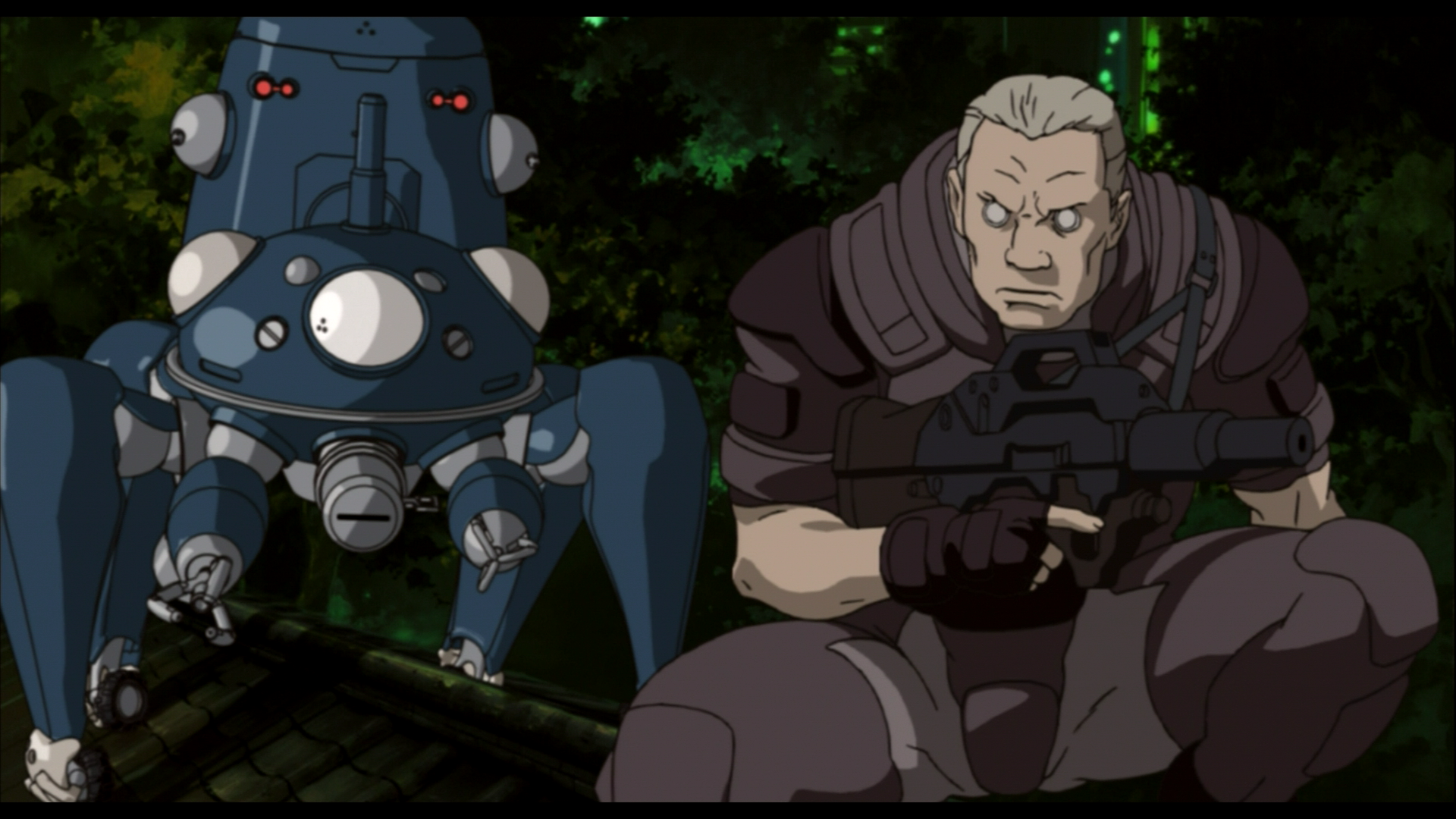
My favorite action scene in SAC!

The hilarious tribute scene in SAC.

OHHH MAI.Unfortunately, to construct a dark an uninviting visage of the future, Mamoru Oshii was forced to get rid of all the jokes and humor present in the original manga. The TV show kept most of it, though sometimes it slightly clashes even with its glamorous post-cyberpunk atmosphere. On the other hand, the heartwarming relations between Batou and the Tachikomas do help lift the entertainment value without dumbing the thing down for wider audience. There's a lot of memorable one-liners and great quotes in both GiTS 1995 and SAC ('I am a living, thinking entity that was created in the sea of information.' from GiTS 1995, '- When you're full prosthetic, can you have sex? - Care to find out?' from SAC; just look no further than on good ol' Wiki:
GiTS 1995,
SAC), but I still prefer GiTS 1995 for its profound philosophical dialogue. Well, SAC too had some philosophy, but it wasn't that original compared to what was said before in GiTS 1995 and even The Matrix. Mamoru Oshii made a movie where they discussed the problems that will likely occur in the future. The SAC writers decided to stick more to the current events, kinda weakening the prophetic quality that the traditionally 'good' cyberpunk works have. As our time goes on, the problems raised in GiTS 1995 are still unresolved, unlike the concepts of blogs, social networks and internet memes, that, I'm pretty sure, will evolve into something totally different sooner or later anyway.
Winner: GiTS 1995
The action.

Here's your fan service!

WATCH THE WATERMELONS!!!!11

Now that's some intense shit right here.

More intense shit.

RESIDENT...

...EEEEVIL.
What is a good cyberpunk movie if it doesn't have the characters kill the shit out of each other? I'm not even sure whom to honor here, as both GiTS 1995 and SAC have plenty really good moments. The final shootout at the end of SAC's first season is a decent contender to the original's tank showdown in terms of intensity, editing and realistic feel. Also, as I've already mentioned, SAC does give several winks to GiTS 1995's memorable action moments. Unfortunately, the TV show has its share of blandness even here. The shootouts in GiTS 1995 were akin to John Woo's early movies, while in SAC they feel a bit generic compared to the likes of Trigun, City Hunter or even Cowboy Bebop. This is compensated by the acrobatics though, as SAC's Motoko is way more agile and swift than in 1995 - actually, this can be said about the whole group of operatives. The Tachikomas are awesome, too, with their powerful arsenal and interesting web gadgets. I'm really lost here - the gunplay is great in GiTS 1995, but the acrobatics are staged more impressively in SAC. I really cannot decide! So...
Winner:
DrawThe graphics.

Nya THIS, mothafucka!Again, a good thinking point. I really like Hiroyuki Okiura's gritty artwork in GiTS 1995, while SAC goes for more mainstream, though still great, flashy comic book designs. As far as the character looks go, Motoko and Aramaki look better in SAC, Batou is more visually badass in GiTS 1995, Togusa is good either way. The mecha designs in the show are much closer to manga than in the movie, and contrary to GiTS 2.0, the polygon models are looking way more organic in SAC due to cel shading - I swear, every reviewer has pointed out how great is the blend of 2D and 3D in the show, and I am myself no exception. So all in all, I'd go with GiTS 1995, because visually it may be less canon, but it is different and more appropriate for the genre in general.
Winner: GiTS 1995
That concludes the main part of this post, as it's easy to determine that
GiTS 1995 is the winner. Surprising, but predictable! Though I would lie if I say that I didn't like the TV show as much. They are just two different entities of the same source material, it's just my personal opinion that GiTS 1995 is superior, simply because it is closer to what the cyberpunk style stands to
me personally. So I still recommend you both - it's a great anime well worth the time of any sci-fi fan.
And now,
bonus number one - my thoughts on Ghost In The Shell 2.0.

Blasphemy!To be 100% honest, I didn't like it much when I saw it. It just feels like a very bad Special Edition of Star Wars, and that's why:
* Why Motoko is a polygon model at the beginning while she remains 2D for the rest of the movie?
* Why is the cool black-yellow-and-grey color scheme of the interfaces changed to orange hue? To avoid copyright claims from the Wachowski bros.?
* These pointless polygon helicopters.
* Not sure about the target audience. If this is meant to appeal to the old fans, I bet their opinion won't differ much from mine. If that's for the newcomers, I'm pretty sure that they will be asleep during the talkie bits and resort to Naruto afterwards, anyway.
* The only logical conclusion I was able to think up: if Oshii-san has ran out of pocket money, is it the way he hoped to replenish it? I'm okay with that, but it would be really nice if there were good 3D modellers involved - in this case, the visuals would become truly impressive, just as the old visuals were incredible back in 1995, so both the old and new fans will 'get it'. But nope, another missed opportunity.
It's not bad either, actually - it's still interesting to see all these newly rendered scenes and stuff, but after you've sat through the end credits, you just realize how pointless it all was.
Bonus
number two - as promised, I'll talk about the franchise entries that I've omitted, extremely briefly:
* GiTS: The Manga - the foundation of basics, released in color long before this became mainstream. The story is engaging, the artwork is fantastic, all in all a classic. As of now, there are even two sequels produced (no movie adaptations yet, though).
* GiTS: Innocence - not a bad movie, but unfortunately, it's boring as sin. I was especially pissed off by the fact that they were building up all this philosophy throughout the whole damn slow motion picture, just for Batou to grab the SMG at the end and... uh.
* GiTS: Solid State Society - a cap to the SAC story. Not really bad, feels like a remake of SAC's first season with all the nitpicks ironed out.
* GiTS: The Game (PSX) - what I personally don't like about that game is that it's all spent in a Tachikoma with no ground missions at all, and the difficulty is somewhere between 'arcade' and 'Nintendo' hard.
* GiTS: SAC (PS2) - played this for about 5 minutes. The graphics are nice, I suppose, but the gameplay hadn't offered anything original within that time.
* GiTS: SAC (PSP) - played for about 15 mins just recently. It's an FPS, and even by the PSP control standards, a really crappy one. The only bits of fun I've had are the Tachikoma animations during the intermission load-ups, but that's about it. If you want some GiTS-inspired gameplay action, I'd recommend sticking to these games:

Oni (PC, MacOS, PS2)
This classic beat 'em up by Bungie is one of the first mainstream video games developed outside of Japan to have (and boast!) anime designs. The whole thing looks like a big tribute to GiTS, just google the artworks or just the main character's name (BTW, it's Konoko - doesn't it rhyme with something?). The game itself is hard as shit, but not unplayable. I've actually beaten it, and still haven't regretted any minute of its bare knuckle, fist-punching, pew-pewing action.

Fear Effect 1 & 2 (PSX)
Another really good and knock-it-the-hell-off hard game that heavily borrows from GiTS and Blade Runner in terms of visual designs. Gameplay-wise it's sort of a Resident Evil clone with cyberpunk storyline, so it can't be exactly called 'survival horror' - rather, 'survival stealth'.

Galerians 1 & 2 (PSX / PS2 resp.)
Haven't played either of those, but from what I understand, they're like Resident Evil cyberpunk clones, too. Though unlike Oni and Fear Effect, the main character's design really sucks, IMO.

Fighting Force 2 (PSX)
This series have started as Streets Of Rage 4, then rebranded to Fighting Force. For the sequel, Core Design has dropped the beat'em up style and replaced it with more traditional Tomb Raider'ish action adventure. Never played much of the sequel, because the camera is wa-ay too fast for me, there's no lock-on, and the backgrounds are terrible. So take it at your own risk.

Coded Arms 1 & 2 (PSP)
A nice two-part shooter with cyberpunk setting and surprisingly good controls. These are hated by everybody for whatever reasons, but I really liked them, at least the first game.

Cyber Org (PSX)
I've already mentioned this action-RPG recently: here and here. You play as one of the three galactic bounty hunters in a quest of good old dungeon crawling interjected with what I call 'the inventory micromanagement'. I don't know why, but the enemy and background designs really remind me of GiTS. Two warnings, though: First, this game was released only in Japan, however 50% of the language (mostly, generic GUI elements) is English. Second: this game is hard as all fuck.

GUNNM: Martian Memory (PSX)
This one is based off the famous GUNNM (a.k.a. Gunmu a.k.a. Battle Angel Alita) manga by Yukito Kishiro, which also had a negatively received anime adaptation. Haven't played the game, though, but judging from Wikipedia and the screenshots, it's a sort of another action-RPG, and the graphics are seemingly not bad at all. The only downside? It was a Japanese exclusive, too, so I suspect the majority of text be untranslated. Actually that's why I haven't tried it out yet.
So here's some Ghost In The Shell for ya. One thing left to say - I just hope I didn't put out anything to deserve hate mail. There'll also be another review of an amazing cyberpunk anime somewhere during this week, as well as many other good stuff. The Cyberpunk Week is all on!

Ms. Kusanagi... You're the man.